



Faculty Development Workshop
| EXECUTIVE SUMMARY REPORT Faculty Development Workshop: Development of Effective MCQs |
| Date & Time: 10th June 2026 | 10:30 AM – 12:30 PM (2 Hours) | Facilitator: Dr. Faizan Munir Khan & Dr. Amina Bint E. Rashid |
| Target Audience: Institutional Faculty (Basic & Clinical Sciences) | Participants: 23 Registered Faculty Members |
1. Executive Overview
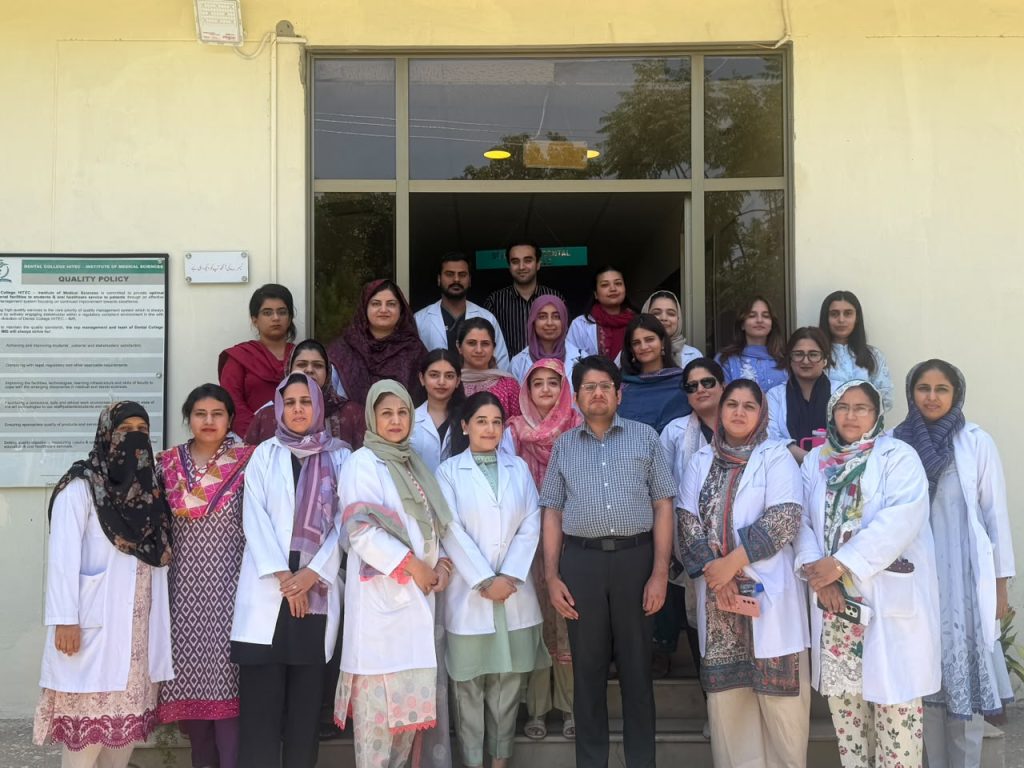
On 10th June 2026, the Dental Education Department conducted a highly interactive, two-hour faculty development workshop dedicated to elevating the quality of written high-stakes assessments. The training session focused on building foundational competencies in examination item development, specifically targeting the mechanics of constructing high-yield Multiple Choice Questions (MCQs) and systematically eliminating common item-writing flaws.
By anchoring the training curriculum in proven cognitive science principles and modern medical education assessment frameworks, the workshop provided attending faculty with immediate, actionable strategies to transition away from low-level rote-memorization items toward context-rich, clinically oriented assessments that accurately gauge clinical reasoning.
2. Participant Profile & Demographics
The workshop secured exceptionally strong cross-departmental buy-in, drawing a total of 23 active faculty members. The cohort represented a deliberate, strategic mix of academic ranks and disciplines, which fostered an invaluable cross-pollination of perspectives between basic scientists and bedside clinical educators.
- Disciplinary Diversity: Balanced representation from both Basic Sciences and Clinical Sciences departments, bridging foundational knowledge with clinical execution.
- Vertical Institutional Hierarchy: Attended by frontline Demonstrators, senior Professors, and the Associate Dean of Basic Sciences.
3. Workshop Objectives & Core Content
The targeted training curriculum was structured around two primary pedagogical pillars:
- Foundational Item Taxonomy: Establishing uniform guidelines for constructing robust stems, highly plausible distractors, and clear, unambiguous lead-ins.
- Flaw Identification & Mitigation: Training faculty to immediately spot and correct common item-writing flaws (e.g., negative stems, ‘all of the above’ options, grammatical cues, and absolute terms like ‘always’ or ‘never’) that inadvertently compromise examination validity.
4. Instructional Design & Interactive Modalities
To optimize engagement and combat online cognitive fatigue, the workshop bypassed traditional passive lecturing in favor of an agile, technology-enhanced, and gamified instructional design. The digital ecosystem utilized four distinct platforms to drive active learning:
| Platform | Deployment Strategy & Educational Function |
| Kahoot! | Gamified Retrieval Practice: Two competitive quizzes were deployed to gamify learning, spark high-energy engagement, and serve as real-time, formative pulse checks on core item-writing concepts. |
| Typeform | Clinical Scenario Modeling: Utilized dynamically to walk faculty step-by-step through the structural assembly of a typical, multi-layered clinical scenario, demonstrating how to anchor stems in authentic practice. |
| Padlet | Collaborative Peer Review: Served as a digital sandbox for a hands-on ‘MCQ Hospital’ activity. Faculty collaborated in real time to dissect flawed sample items, isolate technical errors, and collectively rewrite them. |
| Google Forms | Quality Assurance & Evaluation: Utilized at the session’s conclusion to systematically capture anonymous evaluator feedback, qualitative critiques, and self-reported confidence metrics. |
5. Evaluation & Learning Outcomes
Pre- and Post-Knowledge Testing
To objectively quantify immediate educational impact and knowledge gain, a paired pre- and post-test assessment design was executed. The data points indicated an explicit upward shift in item analysis competency across the entire cohort.
- Pre-Test Baseline: Initial metrics revealed highly variable baseline knowledge across academic tiers. Common misconceptions were heavily concentrated around distractor plausibility limits and the proper structural alignment of clinical vignettes.
- Post-Test Growth: Post-intervention analytics demonstrated a statistically significant upward shift in mean scores. The post-test verified a marked improvement in the faculty’s diagnostic ability to autonomously detect technical flaws and align items with higher-order cognitive domains (Application and Analysis levels).
Evaluation Feedback Trends
- Formal Quantitative Data (Google Forms): Evaluation metrics indicated exceptionally high satisfaction scores. Faculty highly rated the immediate, day-to-day utility of the content and the fluid operational integration of the digital engagement tools.
- Informal Qualitative Feedback: During the interactive closing debrief, participants noted that the hands-on critique workflow on Padlet was highly illuminating. Several senior faculty members remarked that seeing immediate aggregate data visualizations of their peers’ choices on Kahoot! helped them appreciate the real-world value of integrating formative analytics into their own dental student classrooms.